
How to Make a Pitch Deck Investors Actually Read
Learn how to make a pitch deck investors actually read — the 12-slide structure, traction tips, common mistakes, and what BC and Okanagan angels want in 2026.

Here's the number that should change how you think about how to make a pitch deck: investors spend about 2 minutes and 24 seconds on a deck the first time they open it, and only 58% of decks get viewed to the last slide. Your deck isn't competing for a cheque — it's competing for two minutes of attention against every other deck in the same inbox. This guide gives you the slide-by-slide structure that survives that skim, the numbers investors actually linger on, and the Canadian and Okanagan-specific moves that generic US templates never mention.
What a Pitch Deck Is Actually For (Getting the Meeting, Not Closing It)
The single biggest mindset error founders make is treating the deck like a closing document. It isn't. The deck's only job is to earn a meeting. Nobody wires money off a slide; they take a call because the deck made your company feel clear, credible, and fast-moving.
That reframe changes what you include:
- Sell clarity and momentum, not completeness. If an investor has to reread your opening slides to figure out what you do, you've already lost them.
- Leave out the secret sauce. VCs do not sign NDAs for pitch decks, and asking for one flags you as inexperienced. Don't put proprietary IP details in a document designed to be forwarded.
- Assume it gets skimmed on a phone, forwarded without you, and judged in silence.
This matters more in Canada right now than it has in years. Canadian angel investing hit a five-year low in 2025: roughly CAD $113.8M across 490 deals, per NACO's 2026 data. Fewer cheques means pickier readers.
How to Make a Pitch Deck: The 12-Slide Structure That Works
Ask ten investors what to include in a pitch deck and you'll get remarkably consistent answers. The consensus seed pitch deck structure for 2026 follows a narrative arc — problem, solution, proof, path to scale, ask:
- Cover — company name plus a one-line tagline that says what you do in plain English.
- Problem — the customer's pain, stated in their words. Real, recurring, urgent.
- Solution — how you kill that pain. One idea, one slide.
- Why now — the shift (technology, regulation, behaviour) that makes this the moment.
- Market size — with a believable wedge, not just a "$50B TAM" headline.
- Product — screenshots or a short demo flow. Investors process images fast; don't over-invest here.
- Business model — who pays, how much, how often.
- Traction — the proof slide. Hard numbers only (see below).
- Competition — a positioning map. Never claim "no competition"; it signals you haven't done the homework, or worse, there's no market.
- Team — why you are the people who win this market.
- Financials — a simple three-year view.
- Ask — how much you're raising and where it goes.
How long should a pitch deck be? The sweet spot is 10–13 slides. By stage: pre-seed 8–10, seed 10–12 plus an appendix, Series A 12–15. Guy Kawasaki's 10/20/30 rule — 10 slides, 20 minutes, no font under 30 point — remains the most-cited baseline.
Two additions are doing extra underwriting work in 2026: a moat/defensibility slide, and an AI transparency slide — how you use AI in the product or operations, and why you're defensible against AI commoditizing what you do. If either applies, fold it in; if not, don't pad.
Treat this as your working pitch deck template, then study real pitch deck examples (Airbnb's and Uber's seed decks are the classics) to see how few words the good ones use.
The Three Slides That Decide Everything: Problem, Traction, Team
DocSend's viewing data is blunt: at pre-seed and seed, the team slide gets the most viewing time, financials get the second most, and product slides get the least. Investors at this stage are underwriting people and proof, not pixels.
Problem: lead with pain, not product
Open with the customer's pain, not your enthusiasm for your solution. Name who hurts, how often, and what it costs them. If a stranger can't repeat your problem statement after ten seconds, rewrite it.
Traction: the slide numbers linger on
"Why now," business model, and traction pull the longest view times, because hard numbers hold attention. Strong traction slide examples follow a simple format:
- A headline stat — "50% month-over-month growth, 10,000 active users."
- The right metric for your model — ARR for SaaS, GMV for marketplaces, DAU/retention for consumer.
- Social proof — customer logos, pilot partners, a short pull-quote.
Pre-revenue? You still have traction: waitlists, signed LOIs, pilot agreements, partnerships, prototype results, and structured customer interviews all count. What doesn't: calling your MVP "traction," testimonials from friends, or vanity metrics. Writing "10,000 users" when 50 pay reads as deception.
Team: what Canadian angels are underwriting in 2026
For Canadian angels, team remains the number-one factor, but the 2026 emphasis has shifted toward capital efficiency, coachability, and sustainable growth over burn (Angel One Network's "Inside the Canadian Angel Mindset 2026"). Show relevant wins, domain scars, and evidence you do a lot with a little. If you're stretching runway with SR&ED refunds, say so — our SR&ED tax credit guide covers how the newly expanded refundable limits work, and mentioning it in the deck is a capital-efficiency signal investors now reward.

Financials and the Ask: How Much Detail Investors Want
The financials slide of a pitch deck at seed stage is directional, not precise. Nobody believes your Year 3 number; they're checking whether your assumptions match your stage. A simple Y1/Y2/Y3 table showing revenue, expenses, margin, and burn is standard — three years, five at most. Save unit economics, churn, and retention curves for Series A, or for the appendix. Projections that don't match your stage or go-to-market are a top rejection reason.
Your ask slide should state:
- The amount — one number, stated plainly.
- Use of funds — a percentage breakdown, e.g. 40% product, 30% marketing, 20% key hires, 10% operations. Never a line-item budget.
- What it buys — the milestone this round reaches (revenue level, launch, next raise).
Astonishingly, many founders simply omit the ask. Don't. And do not print your valuation in the deck — valuation is negotiated in the meeting, not published in a forwardable PDF. Do know your 3, 6, and 12-month funding needs cold.
One uniquely BC move for your ask slide: if you've registered as an Eligible Business Corporation (EBC) under BC's Small Business Venture Capital program, your local investors can claim a 30% BC tax credit on their investment, up to CAD $300K in credits per investor per year since Budget 2025. That's a legitimate sweetener BC angels notice. For the bigger funding picture, see our guide to getting startup funding in Canada.
A pitch deck for a small business loan is a different animal
If you're pitching a lender rather than an investor, rewrite the back half of the deck. Lenders like BDC care about three things: why you need the money, where it goes, and how it gets repaid. They want conservative assumptions with good/neutral/bad scenarios, a business plan, two-year projections, and evidence you've put your own money in. BDC lends on cash flow, often without collateral, but the deck is only the introduction; the plan does the heavy lifting. Also weigh non-dilutive grants before taking on debt at all.
How to Make a Pitch Deck Look Good (Design Rules for Non-Designers)
You don't need a designer. You need discipline. The core pitch deck design tips, straight from YC's design guidance:
- One idea per slide. If a slide needs a paragraph, it's two slides.
- Big fonts, few words. Kawasaki's 30-point minimum forces you to cut.
- Images and charts over bullets. Investors process visuals in seconds.
- Ruthless consistency — one font family, two or three colours, aligned everything. Investors see 10+ decks a day; clutter reads as sloppy thinking.
An AI pitch deck generator can genuinely help with layout and a first draft — just know what you're buying (July 2026 pricing):
| Tool | Price (USD) | Best for |
|---|---|---|
| Gamma | Free (400 credits); Plus $8/mo, Pro $15–18/mo | Fastest idea-to-deck first draft |
| Beautiful.ai | $12/mo, 14-day trial, no free plan | Auto-adjusting design templates |
| Pitch.com | Free plan; paid from $13/mo | Team collaboration and sharing |
| Slidebean | Free editing; exports from ~$144/yr | Built specifically for investor decks |
Honest framing: AI tools fix ugly slides. They cannot supply your traction numbers or your narrative. A beautifully generated deck with a vague problem and no proof is still a pass.
Send Deck vs Presentation Deck: You Need Both
This is the workflow most first-time founders miss. You need two versions of your pitch deck for investors:
- The send deck — stands alone with no narration, slightly more explanatory text, ~10–12 slides (some investors argue as tight as 5 for cold outreach). This is what goes in emails.
- The presentation deck — visual, minimal text, 12–15 slides plus appendix. You are the narration. As Hustle Fund puts it: never send your 20-slide presentation deck cold.
On sending mechanics: a trackable view-only link (DocSend and similar) is standard and shows you which slides get read. But the number-one investor complaint is forced email gates — turn them off. Some investors trash anything that isn't a plain PDF attachment, so keep a clean PDF ready too; let their preference win.
The 10 Most Common Pitch Deck Mistakes Canadian Founders Make
Run your draft against this list before it leaves your laptop:
- A vague problem statement — the reader can't repeat what you do.
- Text-wall slides or too many slides.
- No story — twelve disconnected slides instead of one argument.
- Missing the ask — the single most avoidable dealbreaker.
- Claiming "no competition."
- A giant market with no wedge — "$50B TAM" and no why-now.
- Financials that don't match your stage or your go-to-market.
- Amateur design — inconsistent fonts, clutter, tiny text.
- No traction signals — not even pre-revenue proof.
- Vanity metrics dressed up as traction.
Two Canadian-specific additions: raising from BC angels without registering as an EBC first (forfeiting their 30% tax credit), and never mentioning SR&ED when it materially extends your runway. Both are free credibility with local investors.
Pitching Live: From Angel Meetings to Okanagan Demo Days
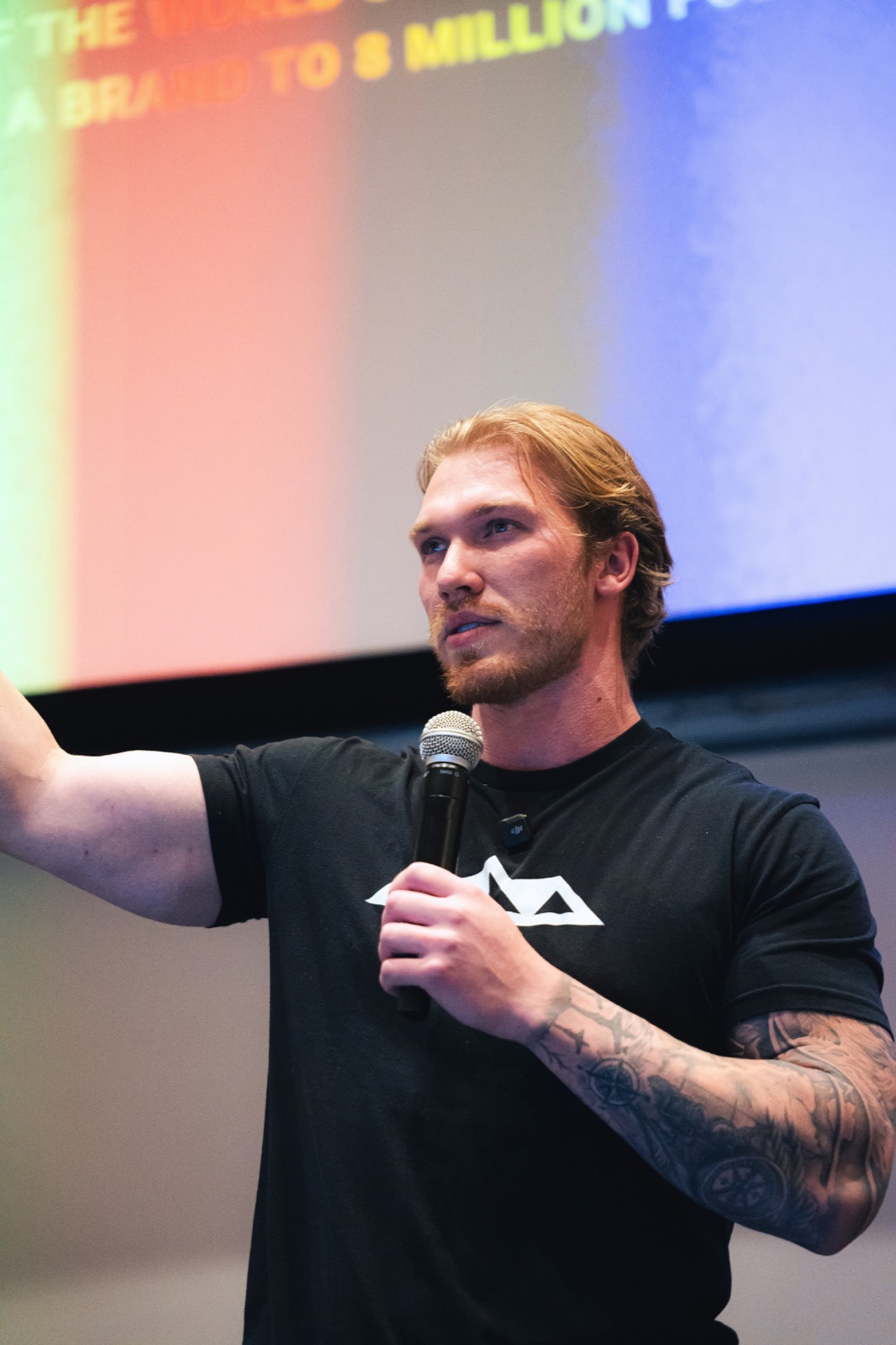
The Okanagan punches above its weight — 787 tech companies, 32,645 jobs, and CAD $4.98B in economic impact — and it has real venues to pitch, each with its own format. Practical demo day pitch tips start with knowing the room:
- Valhalla Angels Kelowna — the first BC chapter, led by Grant Lawrence. Monthly forums feature up to four companies giving 10-minute pitches plus Q&A, then networking. You apply through their Dealum deal-screening application, which requires a financial overview, your pitch deck, and a fact sheet — so your send deck must stand alone before you ever get the room.
- OKGN Angel Summit (Accelerate Okanagan) — an 8-week program with roughly 12 semi-finalists; finalists pitch live at the finale where investors allocate a CAD $200K+ fund. The program teaches deck-building, data rooms, and funding strategy; the 2026 edition ran April 7 to June 4, so watch for the next intake. AO also runs Demo Day Pitch Deconstruction events — one of the best free deck educations in the region.
- New Ventures BC Competition — the Top 10 pitch for CAD $250K in cash prizes plus six months of mentorship.
For a 10-minute angel forum slot, run your presentation deck at roughly a slide a minute, protect the last two minutes for the ask, and rehearse Q&A on financials; that's where angel audiences push hardest. The founders who do best locally have already pitched informally a dozen times, which is exactly what happens at KFC events — members regularly workshop their decks weeks before standing up at a demo day.
Key takeaways
- Your deck has one job: earn the meeting. Investors give it ~2:24 on first pass; only 58% of decks get read to the end.
- Use the 12-slide structure: cover, problem, solution, why now, market, product, business model, traction, competition, team, financials, ask. Aim for 10–13 slides.
- Invest most in problem, traction, and team — team gets the most viewing time at seed, and Canadian angels in 2026 prize capital efficiency and coachability.
- Financials are directional: a simple 3-year table. State the ask with a percentage use-of-funds; never print your valuation.
- Build two decks — a standalone send deck and a visual presentation deck — and keep both a trackable link and a plain PDF ready.
- Use the Canadian edge: EBC registration gets your BC angels a 30% tax credit, and SR&ED strengthens your capital-efficiency story.
- Pitch locally before you pitch for real: Valhalla Angels Kelowna, the OKGN Angel Summit, and New Ventures BC all have defined formats you can prepare for.
Frequently asked questions
How long should a pitch deck be?
The sweet spot is 10–13 slides. By stage: pre-seed 8–10, seed 10–12 plus appendix, Series A 12–15. Kawasaki's 10/20/30 rule is still the best forcing function.
Do investors sign NDAs before seeing a pitch deck?
No. VCs and angels see thousands of decks and will not sign NDAs; asking marks you as inexperienced. Simply keep proprietary IP details out of the deck — sell the problem, the proof, and the team instead.
Should I put my valuation in the pitch deck?
No. State the amount you're raising and the use of funds; valuation gets negotiated in the meeting, not published in a forwardable document. Do know your 3, 6, and 12-month funding needs cold before you walk in.
Should I send a PDF or a trackable link?
A view-only link is the standard and gives you slide-level analytics — but never force viewers to enter an email to open it, which is investors' top complaint. Some investors only accept plain PDF attachments, so keep both ready and match the investor's preference.
What counts as traction if I'm pre-revenue?
Waitlists, signed LOIs, pilot agreements, partnerships, prototype results, and structured customer interviews all count. What doesn't: calling your MVP traction, testimonials from friends, or vanity download numbers that hide a tiny paying base.
Is a pitch deck for a small business loan different?
Yes — lenders like BDC want to know why you need the money, where it goes, and how it's repaid, with conservative good/neutral/bad scenarios. They'll also expect a full business plan, two-year projections, and evidence of your own financial contribution; the deck is just the introduction.
Where can I pitch investors in Kelowna and the Okanagan?
Valhalla Angels Kelowna runs monthly forums with up to four 10-minute pitch slots (apply via their Dealum application). The OKGN Angel Summit puts finalists in front of a CAD $200K+ investor fund, and New Ventures BC awards CAD $250K in cash prizes to its Top 10.
A deck gets better every time someone who's raised before pokes holes in it. Join the Kelowna Founders Club free and workshop your pitch with founders who've stood on the OKGN stage, taken the Valhalla Q&A, and can tell you which slide fell flat.
Kelowna Founders Club
Want the next play first?
Join free and get every guide, speaker insight, and event invite before anyone else. Built by founders in the Okanagan.
Join the club freeSee upcoming events